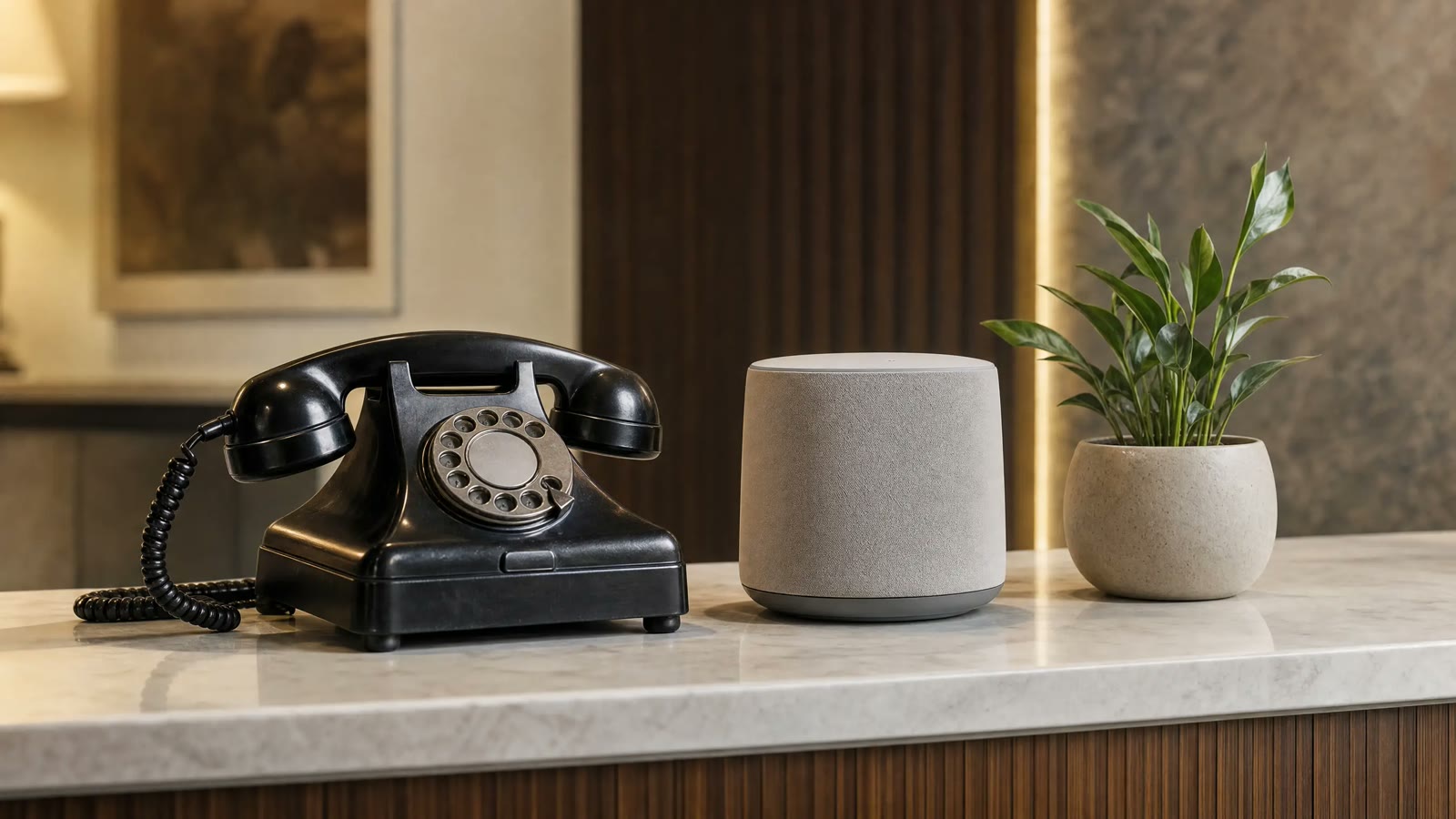
The problem is the calls you never hear about
The oldest number in this category comes from a 2016 study by 411 Locals, which monitored 85 small businesses for a month and found 62 percent of calls never reached a person — a decade old and a small sample, so hold it loosely. The fresher, better-instrumented figure is narrower but still ugly: Invoca's call-platform data puts 27 percent of calls to home-services businesses as never answered.
The part that turns a missed call into a lost customer is what happens next: on the same platform data, fewer than 3 percent of callers who reach voicemail leave a message. The rest hang up, and many dial the next result. Since 62 percent of consumers call before a considered purchase, the phone is usually the last step before money — which is exactly why a machine that answers it is suddenly a product category.
What AI receptionists actually cost
Prices below are from each vendor's own published pricing page, checked August 25, 2026. The metering differs — some sell minutes, some calls, some "customers" — so the middle column is the number to compare.
| Published price | What's metered | Staffed by | |
|---|---|---|---|
| Rosie | $49–$299/mo | 250–2,000 minutes | AI |
| Goodcall | $79–$249/agent/mo | 100–500 unique customers, then $0.50 each | AI |
| Smith.ai AI Receptionist | $0–$500/mo | 25 free calls, then $1.67–$3.00 per call | AI, live-agent add-on per call |
| Slang.ai | $399–$599/mo per location ($379–$539 CAD) | Flat per location | AI, restaurant-focused |
| Ruby | $250–$1,725/mo | 50–500 receptionist minutes | Humans, 24/7 |
| Smith.ai Virtual Receptionist | $300–$2,100/mo | 30–300 calls | Humans |
Read the metering before the headline. A "$49" plan at 250 minutes is fine for a salon fielding three-minute booking calls, and useless for a contractor whose every call is a fifteen-minute scope conversation. Per-call pricing punishes short wrong-number traffic; per-minute pricing punishes long consultative calls. Match the meter to what your calls actually look like — your phone bill already knows.
Against the human alternative
The comparison every owner is silently running: a receptionist in the US earns a median of $18.27 an hour, about $38,010 a year on federal wage data; the Canadian median is $21.00 an hour on Job Bank. Call it $3,200 to $3,700 a month full-time before the employer's payroll costs — against $49 to $599 for the machines, or $250 to $2,100 for a shared human answering service.
That gap looks absurd until you list what the human at the desk actually does: greets walk-ins, handles the delivery, calms the upset patient, notices the schedule conflict, covers forty other small jobs. An AI receptionist replaces exactly one of those — the phone — and only the routine portion of it. The honest comparison isn't "AI versus receptionist." It's "AI versus the calls nobody was answering": evenings, weekends, lunch rushes, and the second line while the first is busy. At that job, $150 a month against a second hire isn't a close decision.
What they handle, and what they fumble
The current tools reliably do more than voicemail ever did: answer instantly at 2am, book and reschedule appointments against your real calendar, answer the ten questions that make up most of your call volume, take a message that's actually structured, and pass the caller to a person when asked. The restaurant-focused ones integrate with reservation systems directly — an independent review of Slang.ai confirms end-to-end booking, changes and cancellations, plus English/Spanish coverage.
The same review documents the edges honestly. Asked to take a phone order, the system texts the caller a link instead of finishing the job. Complex or unusual requests get the same treatment — a link, or a transfer. Every vendor's accuracy depends on how thoroughly you feed it your own details, which is an afternoon of setup work someone has to actually do. And on review sites, the recurring complaint about per-call platforms is billing: calls escalating to paid live agents more often than the owner expected, with the monthly invoice growing to match. Before signing anything, ask two questions: what exactly triggers a paid escalation, and what does canceling take.
Some calls should never route to a machine. An emotional complaint, a medical question, a negotiation. The good setups fail toward humans fast; the bad ones make an upset caller argue with a bot, which costs more than the missed call did.
The payback math, with real numbers
Mindbody's benchmarks put the average salon visit at $63 and the average spa visit at $90. At those tickets, a $149-a-month plan pays for itself the moment it rescues two or three bookings that would have died in voicemail — per month, not per week. For a clinic or a contractor the arithmetic gets one-sided fast: Invoca's home-services model runs it with a $4,500 furnace job, where a single rescued call covers a year of the tool. Their number is an illustration, not an industry average, but the shape of the math holds at any ticket size above the plan fee.
Count your own version in ten minutes: last month's missed calls times the share that were probably bookings times your average ticket. If that number is a few multiples of the plan price, the tool pays. If you get four calls a day and someone's always near the phone, it doesn't — skip it, and let that be the honest end of the pitch.
Where this fits in the automation picture
An answered call still needs somewhere to land. The booking has to reach the calendar, the new number has to reach the CRM, the no-show has to trigger a follow-up — otherwise the AI receptionist is a very polite dead end. That connective work is what our automation line builds: booking into CRM, review requests, quote follow-up, from $1,500 with the monthly covering changes. Same principle we apply everywhere: the machine does the routine, a person approves what customers actually experience.
Two limits to be straight about. We don't resell phone-answering tools or take a commission from any vendor above — the table is research, not a menu, and prices move; check the vendor's page before deciding. And if your call volume is genuinely low, the cheapest fix is the boring one: a tight voicemail greeting that states hours and a booking link, which costs nothing and beats a badly configured robot.
Sources
- Vendor pricing pages, checked 2026-08-25: Rosie, Goodcall, Smith.ai AI Receptionist, Slang.ai, Ruby, Smith.ai Virtual Receptionist
- Invoca, How much missed sales calls cost home services businesses, May 2024
- 411 Locals, Small business owners don't answer 62% of phone calls, January 2016
- O*NET / BLS, Receptionists and information clerks (43-4171), 2025 wage data; Government of Canada Job Bank, receptionist wages (NOC 14101), updated November 2025
- Perfect Venue, Slang.ai review, July 2026
- Mindbody, Beauty and wellness revenue benchmarks, 2025 report
Want the whole front desk to run itself politely?
Book a free consultation and we'll map which of your busywork actually automates well — phones included — before you buy anything. The weekly AI workflows post shows what that looks like in practice, and the owner's guide to AI marketing covers the rest of the stack.